Caching is not a speed button. It is an amortized latency bet: you win when hits dominate, and you lose when the miss rate is high or a stampede turns one expired key into a herd against the database. Teams that "just add Redis" without measuring often find the cache adds latency on the path that matters.
Below is the practical version: the break-even formula, the layer stack (CDN only briefly; that infrastructure story is already covered elsewhere), read and write patterns that hold up under load, invalidation that goes beyond TTL, and stampede mitigations every SaaS cache design should include.
The decision formula
Every request that goes through a cache pays a lookup cost. On a hit you win; on a miss you pay lookup plus the original data access. The average latency is:
AverageTime = DataAccessTime × CacheMissRate + CacheAccessTimeWork the numbers. Suppose DataAccessTime = 100ms (DB + network) and CacheAccessTime = 20ms (Redis round-trip in the same AZ). Without a cache every request costs 100ms. With a cache:
100 × CacheMissRate + 20  <  100
CacheMissRate            <  0.8
If your miss rate is 80% or higher, the cache is net-negative on latency. That threshold moves with the ratio of the two times: a 2ms in-process cache against a 100ms DB gives you a much higher miss budget; a 40ms remote cache against an 80ms DB is unforgiving. Measure hit rate and p99 before you trust the diagram.
Two failure modes hide inside "we cached it":
- Misses still pay the cache round-trip before falling back to the source.
- Population work (CPU, memory, network) only pays off if enough hits follow.
Latency hierarchy (why a hit still matters)
When a cache hit replaces a network hop, the win is often orders of magnitude, not a few percent:

An in-process hit that avoids Redis is cheap. A Redis hit that avoids Postgres is usually worth it. A Redis miss that still hits Postgres is exactly the case the formula above warns about.
The layer stack
Modern apps rarely have "a cache." They have a stack where each layer shields the next:
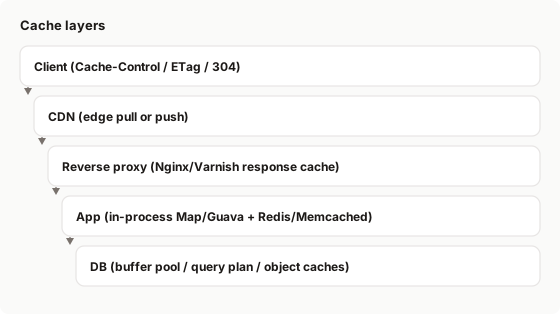
Client. Browsers honor Cache-Control, ETag, and Last-Modified. max-age=3600 caches for an hour; no-cache stores but revalidates; no-store skips caching. Conditional requests return 304 Not Modified without a body when the content is unchanged.
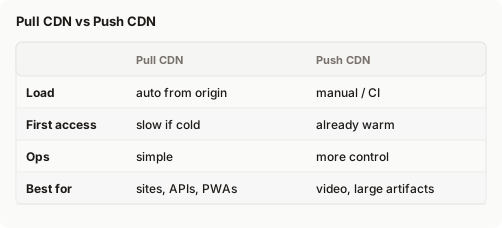
CDN. Edge nodes serve static (and sometimes API) content near the user. Pull CDN fetches from origin on first miss; Push CDN uploads ahead of traffic (releases, large media). I will keep this short here; the networking post already covers CDN as infrastructure.
Reverse proxy. Nginx in front of /products/123 can serve a cached HTML/JSON response without waking the app. Good for mostly-static pages and long-TTL API responses; pair with stale-while-revalidate when you can.
Application. In-process maps for hot, tiny working sets; Redis/Memcached for shared state across pods. The app owns key design, TTL, and invalidation. This is where most SaaS footguns live.
Database. Buffer pools and plan caches are already there. Application-level query-result and object caches sit on top when the same rows or aggregates are hit repeatedly.
Read-intensive patterns
Cache-aside (lazy loading). The application owns the cache. Read path:
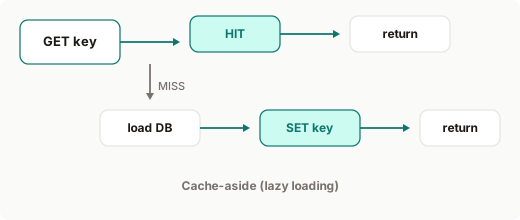
Simple, flexible, and the default for most services. Cost: the first request after expiry is always a miss, and the app must own invalidation on writes.
Read-through. The app always talks to the cache; the cache library loads from the store on miss. Cleaner call sites, less control over population policy.
Refresh-ahead. Predict hot keys and refresh before TTL expires so users rarely see a miss. Useful for CDNs, trading boards, and anything with predictable peaks. Wasteful if your predictor is wrong.
Write-intensive patterns
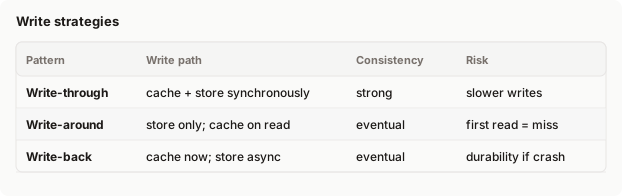
Write-through keeps cache and store aligned. Use it when wrong data is worse than slow writes (ledgers, inventory that must not lie).
Write-around avoids polluting the cache with write-once keys (logs, bulk imports). The next read pays a miss, which is fine when re-reads are rare.
Write-back / write-behind is the speed play: acknowledge after the cache write, flush later. You traded durability. Fine for counters and ephemeral buffers; not fine for money.
TTL, eviction, and jitter
TTL bounds staleness. Too short and the miss rate climbs. Too long and users see yesterday's catalog. Identical TTLs across a hot key set expire together, and synchronized expiry invites a stampede. Add jitter:
ttl = base_ttl * (1 + uniform(-0.10, +0.10)) # ±10%Eviction when memory is full: LRU is the sensible default (recent ≈ relevant). LFU keeps stable popular items and can cling to yesterday's viral post. ARC adapts between recency and frequency when you outgrow LRU and can afford the complexity. Name the algorithm; "we use Redis" does not answer the access pattern by itself.
Invalidation beyond TTL
TTL-only is fine until a product price must change in seconds. Then you need explicit delete/refresh, or better: event-driven invalidation.
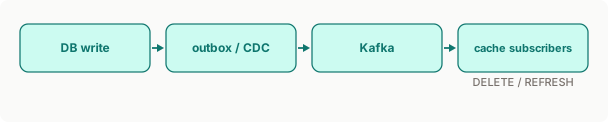
Delete (evict) forces a miss on next read. Refresh writes the new value immediately when you already have it. Tagging and versioning scale invalidation: tag keys with product:456 and drop the whole tag when that product changes; bump a version prefix (v3:user:42) when a release or schema change must clear a generation of entries.
Stampede (thundering herd)
One hot key expires. N concurrent requests all miss. All N hit the database for the same row. Latency cliffs; DB CPU spikes; sometimes the cascade continues.
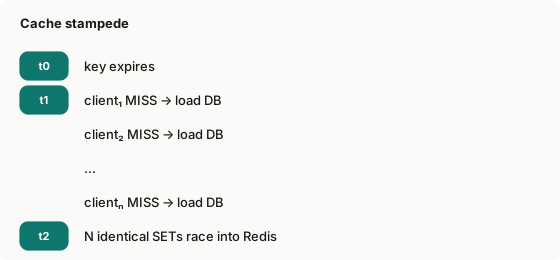
Mitigations that work in production:
- Single-flight / lock: only one loader proceeds; others wait or subscribe for the fill.
- Stale-while-revalidate: serve the expired value while one background refresh runs.
- Probabilistic early expiration: a few requests refresh slightly before TTL so expiry is soft.
- Negative caching: cache
NOT_FOUNDwith a short TTL so missing keys do not hammer the DB. - TTL jitter: as above. Desynchronize mass expiry.
Multi-tenant caching
Always prefix by tenant. Never let a hot key from tenant A collide with tenant B's namespace, and never share mutable tenant data under a global key:
tenant:{tenant_id}:user:{user_id}
tenant:{tenant_id}:product:{sku}
Watch Redis memory as a noisy-neighbor surface: one tenant's unbounded working set can evict everyone else's hot keys. Per-tenant memory budgets, key counts, or separate Redis logical DBs / clusters for large customers turn this from a surprise into a quota.
When not to cache
- Write-heavy unique keys with almost no re-reads. You pay population cost for nothing.
- Rapidly changing inventory without an invalidation path. You will serve lies.
- Secrets and PII without encryption-at-rest controls and a clear TTL/scrub policy.
- Anything where you have not measured miss rate and source latency yet.
Key takeaways
- Compute the miss-rate break-even before adding a cache layer. Low-hit caches add latency.
- Design a stack (client → CDN → proxy → app → Redis → DB), not a single "cache box."
- Pick read/write patterns deliberately: cache-aside for most apps; write-through when consistency wins; write-back only when durability risk is acceptable.
- TTL + jitter + LRU (or ARC) cover the common case; event-driven invalidation covers the rest.
- Stampede is common in production. Use single-flight, SWR, negative caching, and jitter.
- Tenant-prefix every key. Treat Redis memory as a multi-tenant resource.
A good cache is transparent, predictable, and measurable. The decision to use it belongs to metrics, not intuition.